McLaren Artura — Vehicle Access
When the Artura dropped the active dynamics panel, it didn’t just lose a button. It lost the start-up ritual long-time owners knew by heart. The cabin was stripped back and the whole entry sequence had to be reinvented, without costing the car the thing that makes it feel like a McLaren. It’s the brand’s first series-production hybrid; this is how we designed getting into one.
“I had a poster of a 512BB on my wall when I was a kid. I never imagined I would actually ever own one.”
— Mr Kano, 488 owner, Japan
What was lost#
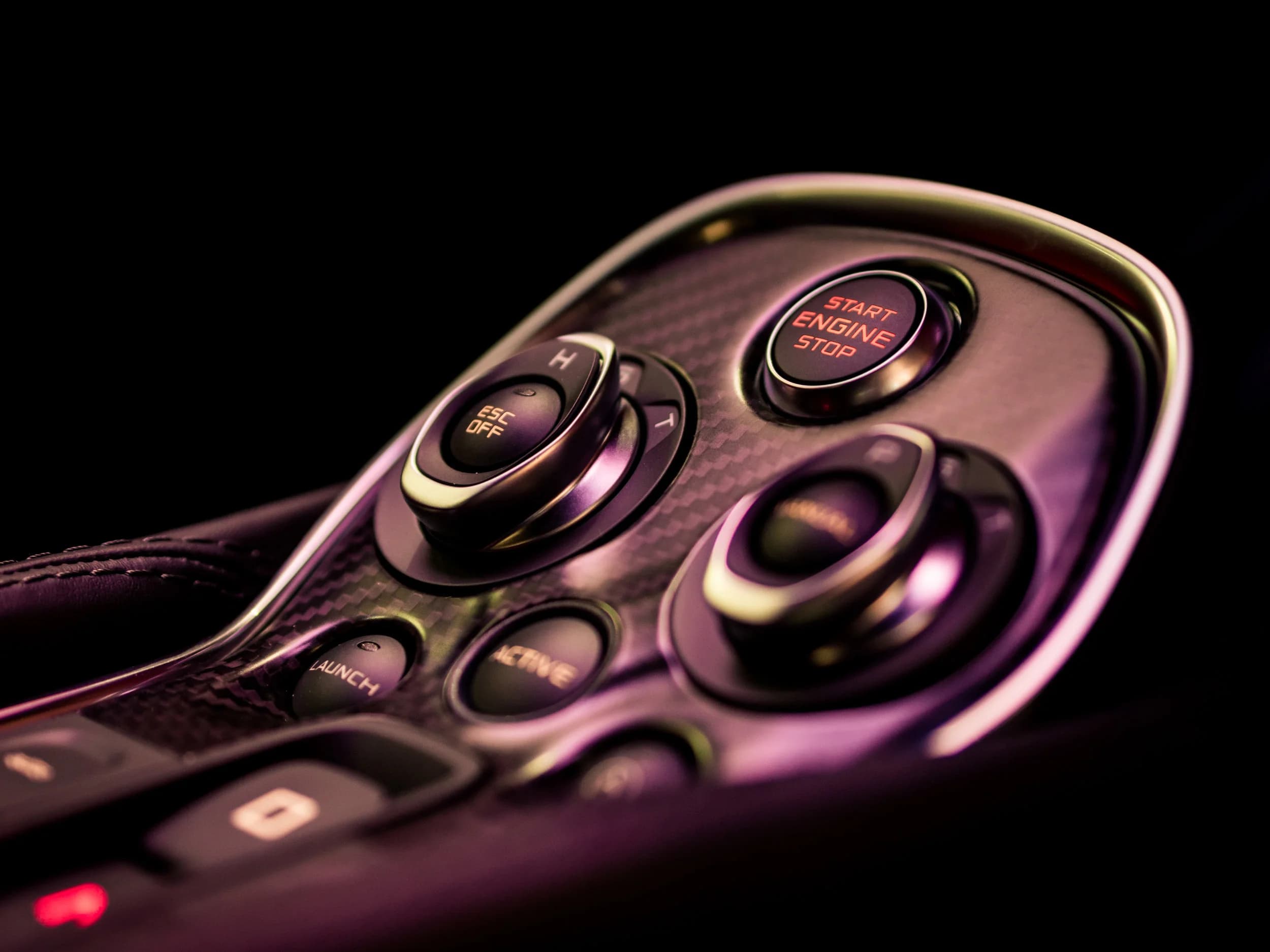
The previous generation cars had an active dynamics panel that did two jobs. It let the driver pick a powertrain and handling mode in one motion, and it guaranteed the car always started in a default mode that complied with emissions legislation.
On the Artura, that panel was gone. Both jobs (the driver shortcut and the legal default) had to survive without it.
Who we were designing for#
McLaren customers sit at the top of their profession. Most have built their own businesses or run them; they have a serious work ethic and very little free time. Time, not money, is the scarce resource. They expect to be valued, recognising good service and poor service instantly from their working lives. And the purchase is emotional, not rational: a rational buyer would walk into a Mercedes dealer and order an SL63.
That’s the constraint that shaped everything: the entry sequence had to feel earned, not transactional.
Three customer archetypes
What was breaking#
We mapped the entry sequence on the 720S and other legacy cars and surfaced four recurring problems.
Pain points
- Cluster boot times. The ADI booted too slowly. Owners opened the door, sat down, started the car, and only then saw the comfort-entry prompt arrive.
- Comfort entry disengaging on engine start. Safety logic was too cautious about movement during the 2–3 second comfort-entry animation. Start the engine in that window and the whole sequence was abandoned.
- No user detection. No profiles existed on the system. If a tall driver took over from a shorter one mid-day, the cabin stayed configured for the previous person.
- Removal of the active panel. Setting up a McLaren for a track day (powertrain mode, handling mode, ESC off, manual transmission, brake, start) was a ritual by design. Without the panel, the ritual would have to be re-performed on every ignition cycle.
Vehicle detects the key.
The cluster starts booting up, which may take up to 10 seconds.
* If booted up on time. There were cases where the user started the vehicle before comfort entry was available and lost the chance to activate it.
Drivers reported the vehicle sometimes wasn’t displaying the speed and was still booting up after the car had started running.
On a change of driver (for example, on a track day) the user had to set up the vehicle again from scratch. There was no intuitive way to perform this task.
Recognition over ritual#
The absence of the panel wasn’t a hole. It was an opening. The car could arrive already configured, recognising its owner before the door was even open. Both of the panel’s old jobs survived, just relocated. The driver’s shortcut became a single touch to confirm it’s you rather than a control to operate; recognition is never assumed as the default. And the legal default stayed exactly that: every ignition still comes up road- and emission-legal, the floor recognition layers on top of and never overrides. We knew how sacred the start-up ritual was, so the brief was always to make it simpler, never to take it away.
From the pain points, two situations kept surfacing in research.
When I’m getting into my car, I want it to be personalised, so I can feel right at home and get going faster.
When I’m at the track and have just taken a coffee break, I want to quickly get back to my preferred settings, so I don’t have to fiddle with the controls again.
Ideation#
Three concepts emerged for how the car might recognise its driver, ranging from pure hardware detection to a soft assumption about who drove it last.
User walks to the car. The key detects the user at 10m and customises the environment.
Automatic comfort entry, triggered on door close, based on the profile.
User detection based on device MAC addresses.
User walks to the car. The key detects the Bluetooth devices in the vicinity and forms a footprint.
The vehicle automatically assumes the previous user. Automatic comfort coupled with profile selection.
Option 1 was the one I actually wanted: the key detecting the driver at range, the cabin configuring itself with nothing assumed. But it threw too many false positives, and a feature that guesses wrong often enough is a feature owners learn to distrust. Option 2 fingerprinted the Bluetooth devices in the vicinity to work out who was approaching, which would have broken a dozen GDPR laws before the car ever left the factory.
Option 3 carried forward into the spec on three counts. It required no new hardware, it failed gracefully (the wrong profile is still a configured cabin, not a broken one), and it was the only option that could ship inside the development window without holding up the rest of the programme.
The revised journey#
We pushed the experience earlier (well before the door opens) and let the car do the recognition work in the background. The first three steps happen before the owner has touched the car. By the time the door closes, the cabin already knows who is driving.
Vehicle detects the key.
Headlights turn on to 10% and pulse at 20/minute. The previous profile is assumed. The cluster starts booting up.
Headlights stop pulsing. Mirrors unfold and the signal lamps blink.
Footwell lights and ambient lighting turn on. A synchronised animation plays across the cluster and the centre display.
If the key is detected inside the vehicle, the infotainment system becomes live. The powertrain is available to activate. The driver can select or change the profile and restore the previous vehicle setup through the centre display.
Specifying the system#
With the journey agreed, every permutation had to be defined so the development team could ship without ambiguity.
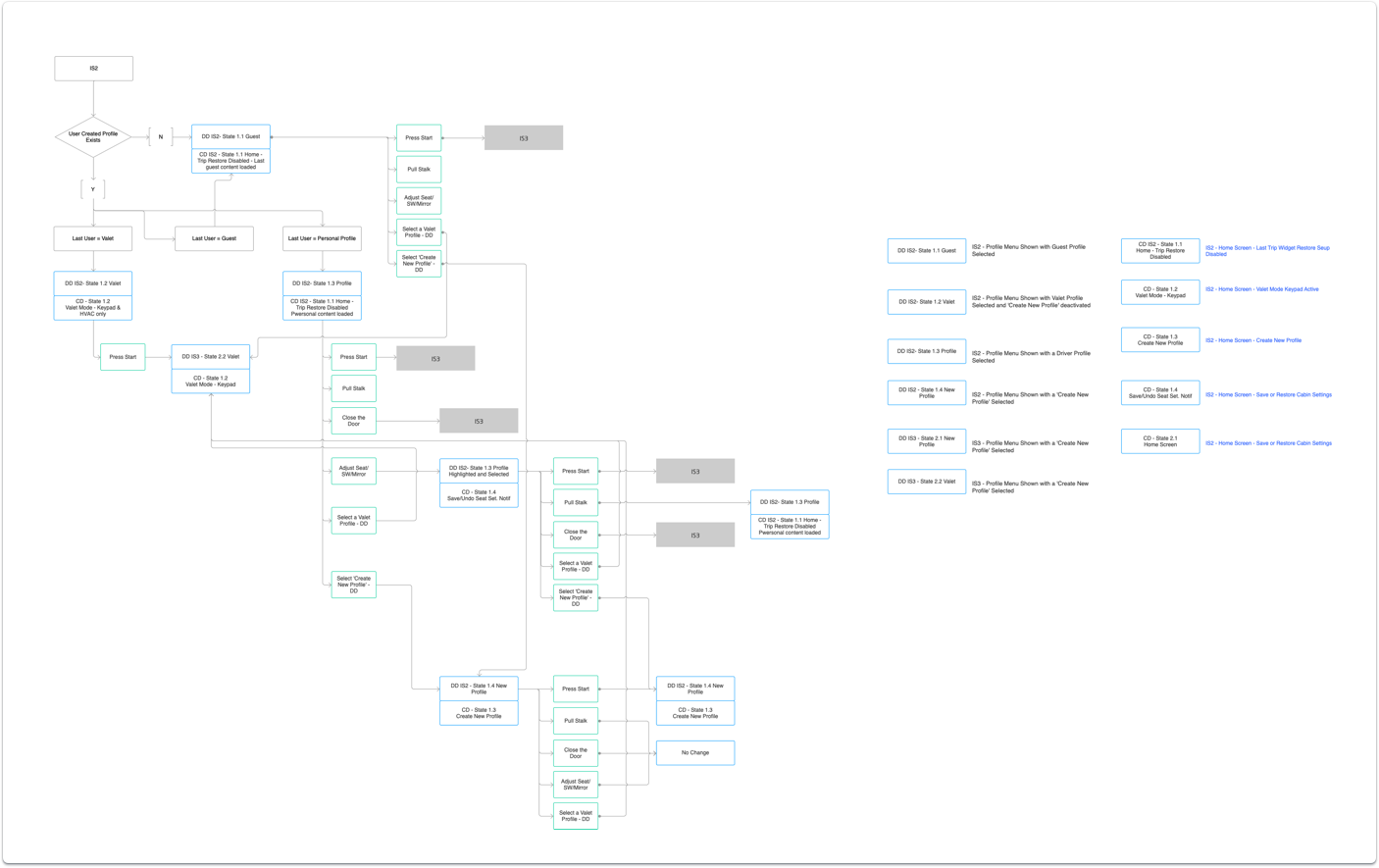
Information architecture — Ignition State 2
Ignition State 2 (car unlocked, not yet started) was the busiest junction in the flow. From here the driver could press start, open or close the door, select a restricted profile like Guest or Valet, or adjust cabin configuration. Every permutation across the driver display and the centre display had to be defined.
Wireframes
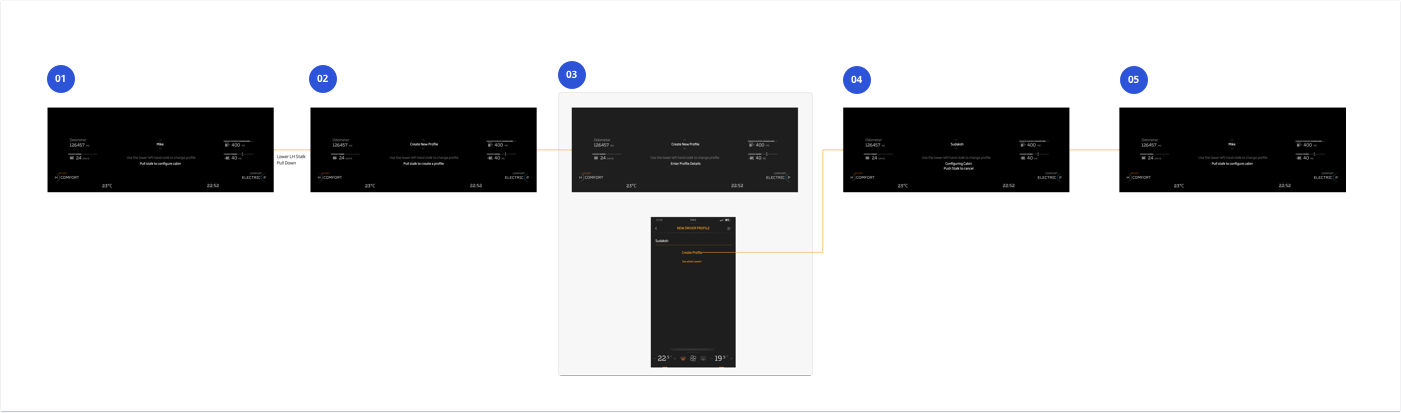
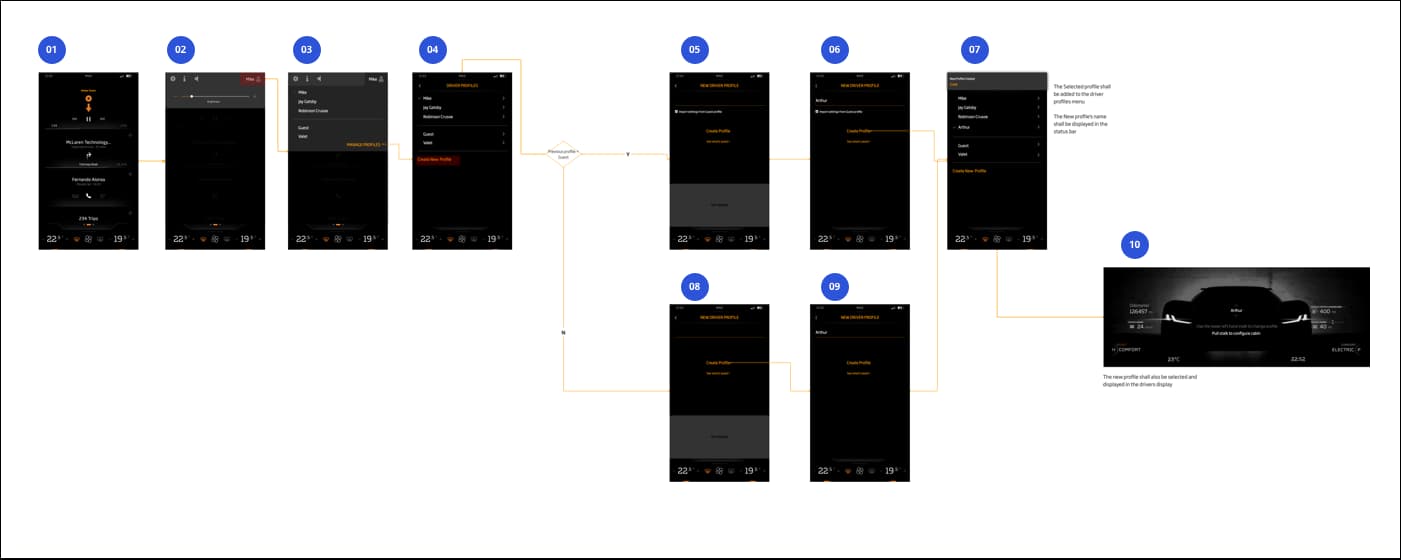
Drivers’ hands are rarely in the same place twice, so the profile-creation flow had to start from either display.
Outcome#
The system design specification and UX specification were delivered on schedule in March 2019 and carried forward into the Artura programme. The Artura launched in 2022 as McLaren’s first High-Performance Hybrid, and the first production car in the range to ship with the profiles feature, the hybrid powertrain HMI, and over-the-air firmware updates.
The entry sequence designed here (pulsing headlights at 25m, the synchronised cluster animation on door open, the cabin already configured before the engine is ever started) is what owners encounter every time they walk up to the car.
Method#
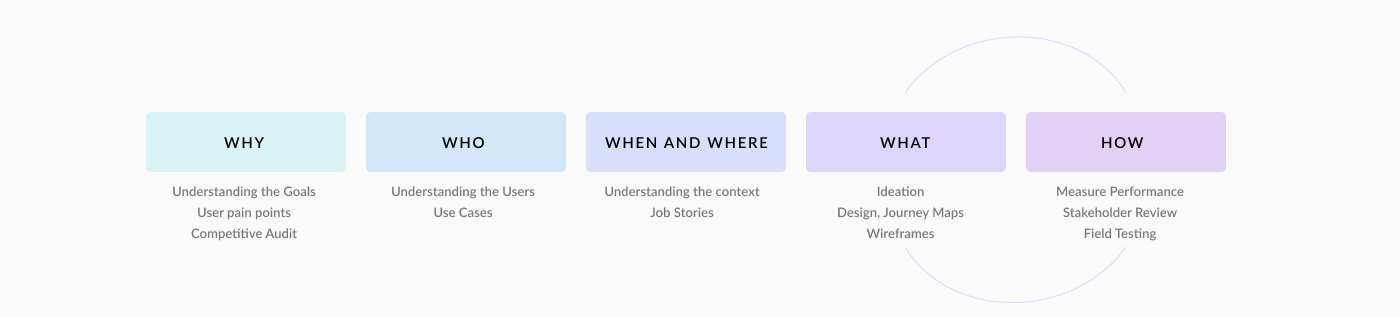
The work moved through five passes (Why, Who, When and Where, What, How) covering goals and competitive audit, user research and use cases, context and job stories, ideation and wireframes, and finally measurement, stakeholder review, and field testing.